





















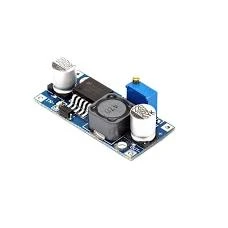
The LM2596 Buck Converter Module is a high-efficiency DC-DC step-down voltage regulator widely used in IoT, robotics, power supply design, and embedded research projects. It is based on the LM2596S switching regulator IC and provides a stable, adjustable DC output from a higher DC input voltage.
This module is favored in research because of its efficiency (~80–92%), compact design, and ability to handle moderate loads, making it suitable for powering microcontrollers, sensors, and battery-based systems.
Key specifications:
-
Input Voltage: 4.5V – 40V DC
-
Output Voltage: 1.25V – 37V DC (adjustable using onboard potentiometer)
-
Output Current (continuous): Up to 2A reliably (peak 3A with heat dissipation)
-
Efficiency: 80% – 92% (varies with load and input-output difference)
-
Switching Frequency: ~150 kHz
-
Voltage Ripple: <30 mV (typical with proper capacitors)
-
Load Regulation: ±0.5%
-
Output Type: Adjustable regulated DC
-
Protections (module-dependent): Input overvoltage, thermal shutdown, short-circuit protection (basic IC protection)
-
Operating Temperature: -40°C to +125°C
Research & application relevance:
-
IoT Prototypes: Efficiently steps down 12V/24V power sources to 5V/3.3V for ESP32, NodeMCU, or Arduino.
-
Robotics & Automation: Powers motor drivers, sensors, and control boards from higher-voltage Li-ion or lead-acid batteries.
-
Embedded Systems Research: Enables experiments with regulated supply design, power efficiency, and load testing.
-
Battery-Powered Systems: Often paired with 18650 packs + BMS to create regulated outputs.
-
DIY Lab Power Supplies: Commonly used in research labs for low-cost adjustable power modules.
Its wide input range, high efficiency, and adjustable output make the LM2596 buck converter a standard in academic and prototyping environments.